

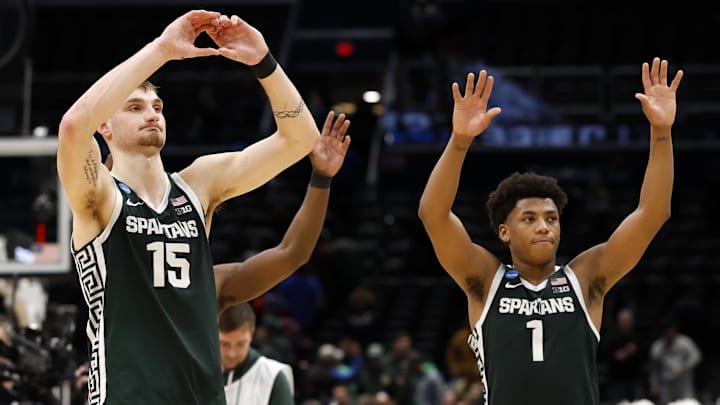
Tom Izzo has himself a fun Michigan State basketball team for a second straight season, but like last year, the Spartans fell short of their ultimate goal: a national title.
Winning No. 2 for Izzo isn’t going to be easy, but we’ll have to hope that the 2026-27 squad will have what it takes to cut down the nets in Detroit.
Before we get into that, let’s reflect on the season that was and hand out final grades.
Jeremy Fears Jr.: A
Jeremy Fears Jr. led the team in scoring, assists, steals, and free throw percentage, and he was named a second-team All-American. He averaged 15.2 points, broke the school record for assists and averaged a nation-high 9.4 per game, and he worked on his 3-point shooting to get it up to 32.1% before the season ended. Fears is elite and it’s obvious that he’s developing into an all-time Spartan great.
Coen Carr: B+
Coen Carr was second on the team in minutes behind only Fears, and he averaged the third-most points on the team at 12 per game. Carr averaged 5.8 rebounds as well and looked like he was growing into more of an all-around player. His defense improved and he got a little more comfortable with his jumper, making nearly 52 percent of his shots from the field and almost 28 percent from deep. He gets a B+ just because he disappeared too much and hasn’t realized his dominance yet.
Jaxon Kohler: A-
If not for a mid-season lull, Jaxon Kohler would have easily gotten an A, and he may have been in contention with Fears for an A+ — I opted not to give anyone that grade because it signifies near-perfection. Kohler got off to a fantastic start to the year before struggling for a few weeks and then he got back on track to end the year. He had a career year, averaging 12.5 points and 8.9 rebounds while shooting 50 percent from the field and about 39 percent from deep. Kohler’s presence is going to be missed big-time.
Carson Cooper: A-
Speaking of presences that will be missed, Carson Cooper was the most improved player on the roster, finishing his career by averaging 11.1 points, 7.1 rebounds, and 1.0 blocks per game. He was really good this season and probably deserving of an A, but I think he was right on that same level as Kohler. Cooper developed from a zero-star recruit into a Big Ten-caliber starting center. Talk about elite development by Izzo.
Jordan Scott: B
If the season ended after the Purdue game, I would probably have graded Jordan Scott an A- or a B+, but the final three weeks of the season were just not great for him. He hit a bit of a freshman wall offensively, failing to score over 10 points in the final nine games of the year after six straight double-digit scoring games in February. Defensively, he was strong and he was a 3-point specialist, but he’ll need to work on his offense this offseason. He averaged 5.8 points and 3.1 rebounds as a freshman.
Kur Teng: B
I expected a little more out of Kur Teng this season, but you can’t be too mad at 7.3 points and 38 percent shooting from deep from a guy who didn’t really see the court as a freshman and was thrust into the starting lineup to begin this season. He had a few breakout games and showed that he can be an absolute marksman from deep, but he needs to work on his overall confidence — it did grow as the season progressed.
Divine Ugochukwu: B+
I was pleasantly surprised by Divine Ugochukwu in his first year with Michigan State after coming over from Miami, and he became one of the most improved 3-point shooters in college basketball. In fact, he shot just 17.6% with Miami last year and he improved that to 44.2% this season. If he didn’t get hurt, he could’ve been the difference between a Sweet 16 berth and a Final Four run. He’s going to have a Tre Holloman-type role next year.
Cam Ward: B-
Cam Ward’s grade seems a little unfair, and that’s because it is. He gets a B- not because he was disappointing, but rather because a wrist injury really changed the course of his freshman season after a red-hot start. He did gain some confidence again near the end of the year, but that wrist clearly bothered him. He still managed to averaged 5.1 points and 4.2 rebounds per game and it felt like he was automatic when he backed down a smaller defender. This is a big offseason for him — I believe he can become a dominant forward.
Trey Fort: C
It was a little painful to give Trey Fort a grade because he was such a good teammate and person, but he drastically fell short of expectations. The Samford transfer was supposed to be a go-to scorer for the Spartans but he just never saw the court consistently, averaging 10.2 minutes over 33 games. He had some scoring outbursts, especially in the NCAA Tournament, but he averaged just 4.2 points and shot 35 percent from the floor. It was a disappointing season, but at least it ended on a high note for him personally.
Jesse McCulloch: C+
It almost feels unfair to give Jesse McCulloch a grade because he can’t quite finish with an A or a B because he appeared in just 28 of 35 games and he averaged only 7.4 minutes in those contests. He didn’t see the court much, but he showed promise and that’s all you can ask for. He shot 50 percent from three and 48 percent from the field, averaging 2.4 points and 1.3 rebounds.
Denham Wojcik: C-
This grade isn't a knock on him, but he was kind of forced into a bigger role than he was expecting and really a bigger role than he was ready for. He handled it decently well, but he was outmatched regularly, but he got better offensively at the end of the season.
Tom Izzo: A-
This was one of Izzo’s better coaching jobs, but I wouldn’t quite give him an A because he had some poor performances throughout the year where his team kind of fell apart in clutch time (Duke, Michigan twice, UConn) and slow starts were commonplace. Still, he took a team that lost three starters and four role role players from a Big Ten title squad and went 27-8 with a second weekend appearance in the NCAA Tournament. More is expected next season.
 Add us as a preferred source on Google