

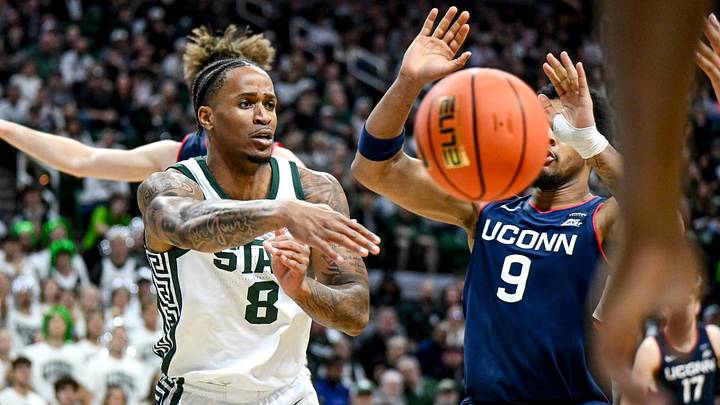
Kaleb Glenn's commitment to Michigan State out of the portal was a great day for the Spartans. Glenn was a top-100-ranked portal player coming to a team that desperately needed his outside shooting and athleticism.
Just two months later, the gut-wrenching news broke that Glenn had torn his patellar tendon during a workout with the team. This would ultimately end his season before it began and give him a year-long rehabilitation process.
So what should we be expecting from Glenn this year? Is this the same player as before or will he ever be?
Those are some very tough questions with a lot of variables.
What should we expect from Kaleb Glenn in 2026-27?
To fully understand what to expect from Glenn this season, we first need to look into the injury.
What we know is that June 16, 2025, Kaleb went up for a dunk during practice and felt a "pop" just as he gathered and jumped. He then underwent surgery to repair his ruptured right patellar tendon three days later.
With the use of the term "rupture" and his surgery taking place three days later, it's safe to assume Glenn suffered a grade-3 tear. Graded on a scale of 1-3, a grade-3 tear occurs when the tendon fully tears away from the bone. Surgery is almost always recommended for a grade-3 tear in an attempt to bring back normal tendon function. Unfortunately, once a structure in the body tears, it is unlikely it will ever be back to pre-injury form.
Whether he regains full function or not is impossible to say. You don't know how much this could affect his athleticism on the court. It's all about how he and his body react to his rehab.
Now that we talked a little bit about the mechanism of injury, we can now project what to expect from the redshirt junior. So far, in limited minutes, Glenn has brought physicality and a calming veteran presence off the bench. Through his first four regular season games, he logged 12 minutes against Quinnipiac, 15 against Toledo, eight against Duke, and 18 against Northern Iowa. Although his minutes have been up and down, he has been noticeable on the court.
Glenn has been able to use his frame to get inside position on the glass and he's very difficult to move once he's there. He's brought down 3.5 boards per game with nine of those on the offensive glass. Though he hasn't found his touch from three just yet, he's been able to get into the paint and draw fouls at a high rate. Once the threes begin to fall, expect some big games off the bench for Glenn this season.
The next question we'll have to wait and find out the answer to is what type of player Glenn will be when he's back. Nearly 17 months removed from surgery, I'd imagine the main goal for him right now is still just strengthening that right leg.
With a patellar tendon rupture, Glenn likely went multiple days and/or weeks not being able to contract his right quadricep, let alone bear weight on it. This would cause significant atrophy to that right leg, which is still present. Atrophy is the term for a decrease in the size of a tissue or cell, and in this case it's due to disuse. This hasn't seemed to slow Glenn down at all to start the year. He doesn't look like a player who just missed a full year due to a major leg injury and that is great news for the rest of his season.
Seeing Glenn play some big minutes off the bench to start the season shows Izzo has trust in him early. If Michigan State wants to achieve its goals for this season, Glenn will need to be an important piece off the bench. He’s handled the minutes he’s been given so far, but he’ll be tested again in Knoxville on Tuesday evening.
 Add us as a preferred source on Google